

Giphy
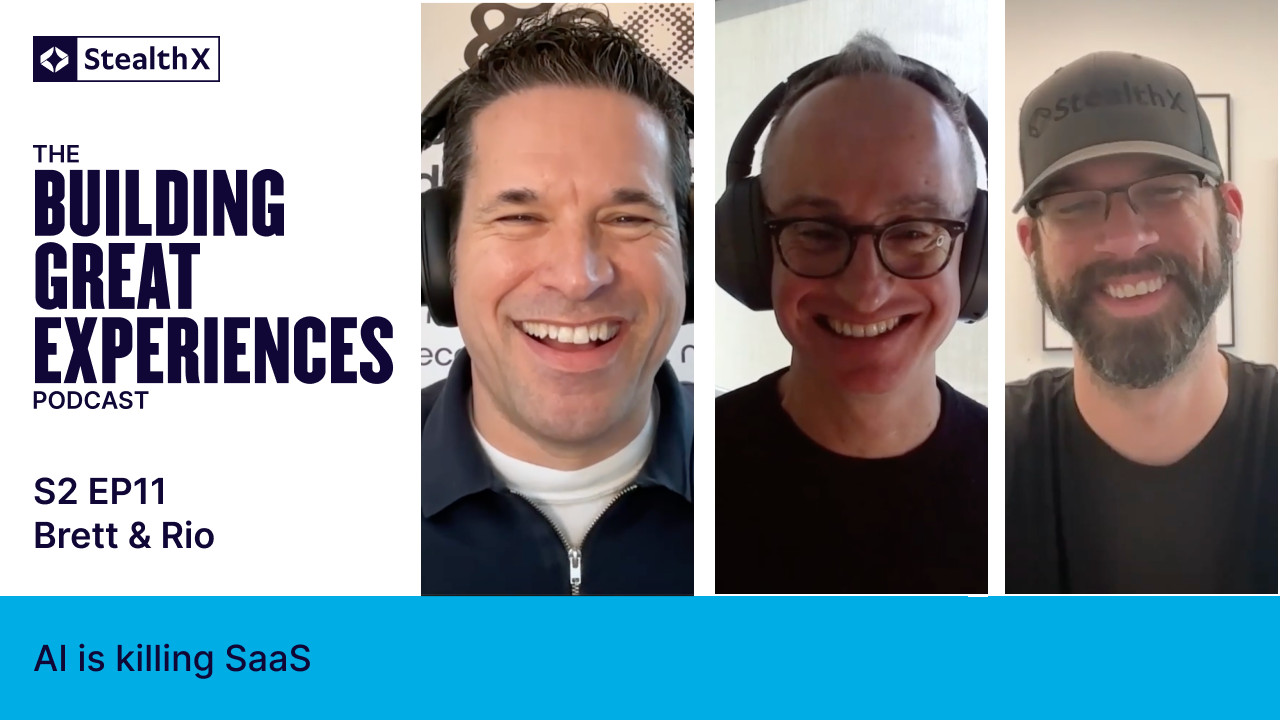
A few weeks ago I had Brett House and Rio Longacre on the Building Great Experiences podcast. Brett is the Founder and CEO of High Signals, and Rio leads advertising and AdTech at Credera. They also co-host a great podcast called Signal & Noise that covers AdTech and MarTech trends.
It was an awesome conversation that covered a ton of ground. We got into a great debate on whether AI agents will start buying things for us, why go-to-market is compressing from months to days, and what happens when the concept of a "power user" stops making sense entirely. Here's a brain dump of the biggest takeaways from the conversation.
1. Go-to-market has compressed from months to days
Since launching High Signals in December, Brett shared that he’s pivoted his positioning multiple times, and each pivot took three to four days instead of three to four months. He's using AI to run competitive SWOT analyses, simulate focus groups, and pressure-test messaging in a fraction of the time it used to take a full product marketing team.
Speed cuts both ways thought. Brett put it bluntly, "If you start with a bad foundation, AI will just blow up the noise." Rio agreed and added that AI will tell you what you want to hear if you let it. If you keep feeding it positive reinforcement, it'll just layer on confirmation bias.
The takeaway isn't that AI makes go-to-market faster. It's that AI makes everything faster, including your mistakes. You still need clarity on who you're selling to, what problem you're solving, and whether people actually want what you're building. The best product doesn't win. A great product with clear positioning, market fit, and great marketing and distribution wins. AI just compresses the timeline on all of it.
2. The agentic commerce debate
I shared a recent article from Brian Flynn about what happens when AI agents start making buying decisions on our behalf. The idea is that as personal AI assistants get more capable, they'll evaluate products and services based on ROI per token usage, hit APIs for pricing, and make purchasing recommendations without you ever visiting a website.

Brian Flynn’s interesting take on selling to AI Agents
Brett played devil's advocate immediately. His take is that agentic commerce without human agency is "a solution looking for a problem." He compared it to the internet of things, where your refrigerator was supposed to order milk for you and nobody actually wanted that. He thinks AI-powered recommendations will happen inside existing platforms like Amazon's Subscribe and Save, but the idea of an agent autonomously making purchases on your behalf is overhyped.
Rio disagreed. His argument is that we'll get comfortable with it over time, the same way we got comfortable buying things online. Thirty years ago, people were faxing credit card numbers to Amazon because typing them into a website felt risky. Give it time, and the discomfort fades.
I tend to land somewhere in the middle. I don't think anyone's going to trust an agent to buy them a car or a house. But software? That's a different story. And I'll tell you why I believe that, because I just lived it.
3. I cancelled HubSpot (and let AI pick the replacement)
Two days before we recorded this episode, I had Claude Code rebuild our CRM. It pulled all of our data out of HubSpot via the API, recommended a Supabase backend (about $10/month versus what we were paying for a dozen seats on HubSpot), suggested Resend for email delivery at pennies per thousand, and set the whole thing up. I cancelled HubSpot the next day.
Here's what's interesting. I didn't pick Supabase. I didn't pick Resend. The agent recommended them, and I just said "sounds good, go." It could've recommended a dozen other tools and I wouldn't have known the difference, because I didn't care about the tool. I cared about the outcome.
That's the agentic commerce question in practice. When an AI agent is building your tools and selecting your services, who are you actually selling to? The human who just wants the problem solved, or the agent who's optimizing for efficiency? This is going to be a real challenge for SaaS companies, especially in the mid-market where the bloated platforms are hardest to justify.
Rio made a smart point here too. A friend of his had agents going through emails, filtering inbound, crafting responses, and reviewing pitches, and it was burning $300 a day in tokens. This stuff isn't free. Costs will come down, but the idea that agents automatically save money isn't a given.
Quick disclaimer: Obviously we (StealthX) are not a massive company, so building our own CRM makes sense for us. The jury’s still out if this is a smart move for larger companies. I lean towards no right now, although that may change quickly..
4. The death of the power user
This was my favorite moment of the conversation. Rio said something I haven't been able to stop thinking about. "AI-native software will put a stake in the heart of the concept of a power user."
Think about it.. why should your software have 50 knobs and controls? The only reason is because there was no other way. People were trained to use complex tools because complexity was the price of capability. That's changing.
And then, unprompted, something happened that proved the point. I've been building an internal operating system using Claude Code with a team of AI agents (a COO, CMO, CTO, and CFO) that I can delegate to from the terminal. I told my COO agent: "Look at all the status logs and transcripts from the last month and make some recommendations on stuff we should build."
A few minutes later it came back with several ideas, including a client health dashboard based on automated analysis of sentiment across meeting transcripts, flagged signals in Slack channels, and email indicators. I was stunned and (foolishly) can’t believe I didn’t have the idea. I told to built that and within 20-minutes I had a client health dashboard with a red/yellow/green view of every active account. Two accounts showed early warning flags based on slightly off comments in recent calls.
I'd been trying to figure out how to keep a strong pulse on project delivery for months and Claude Code just built it for me without being asked. No UI to learn, no configuration, no "power user" training. Just a question and an outcome.
That's the future Rio was describing. Instead of logging into a CRM and looking at dashboards, you just ask "what customers are stuck right now?" and get the answer. The software becomes invisible, the outcome is what matters.
5. English is the coding language
Simply put, you don't need to write Python anymore. You need to think clearly and communicate well.
This is what I keep telling business leaders. Forget about 10x. Each one of us has the opportunity to be 30x, 50x, even 100x. And the unlock isn't learning to code. It's learning to think clearly about what you want and communicating that to an AI that can execute.
Also, now anyone can write in plain English and agents can build working software, APIs, dashboards, and automations.
Before you do anything, ask yourself.. “Can I delegate this to AI?” Start there and focus your energy on the decisions that genuinely need you, the strategic calls, the relationship judgment, the creative direction.
Putting this into action
Before you build, buy, or assign anything this week, ask one question: can an agent do this? Delegate everything possible to AI first, then focus on the decisions that genuinely need your judgment.
Stop designing for power users. If your product or internal tool requires a training manual, that's a signal. Start thinking about conversational interfaces and outcome-based interactions instead of feature-based ones.
Wrapping up
The companies that win from here aren't the ones with the most sophisticated tech stack. They're the ones that move fast, think clearly about their customers, and aren't afraid to rip out the things that aren't working. The power user era rewarded complexity. The next era rewards clarity.
Onward & upward,
Drew
P.s. If we haven’t met yet, hello! I’m Drew Burdick, Founder and Managing Partner at StealthX. We work with brands to design & build great customer experiences that win. I share ideas weekly through this newsletter & over on the Building Great Experiences podcast. Have a question? Feel free to contact us, I’d love to hear from you.